
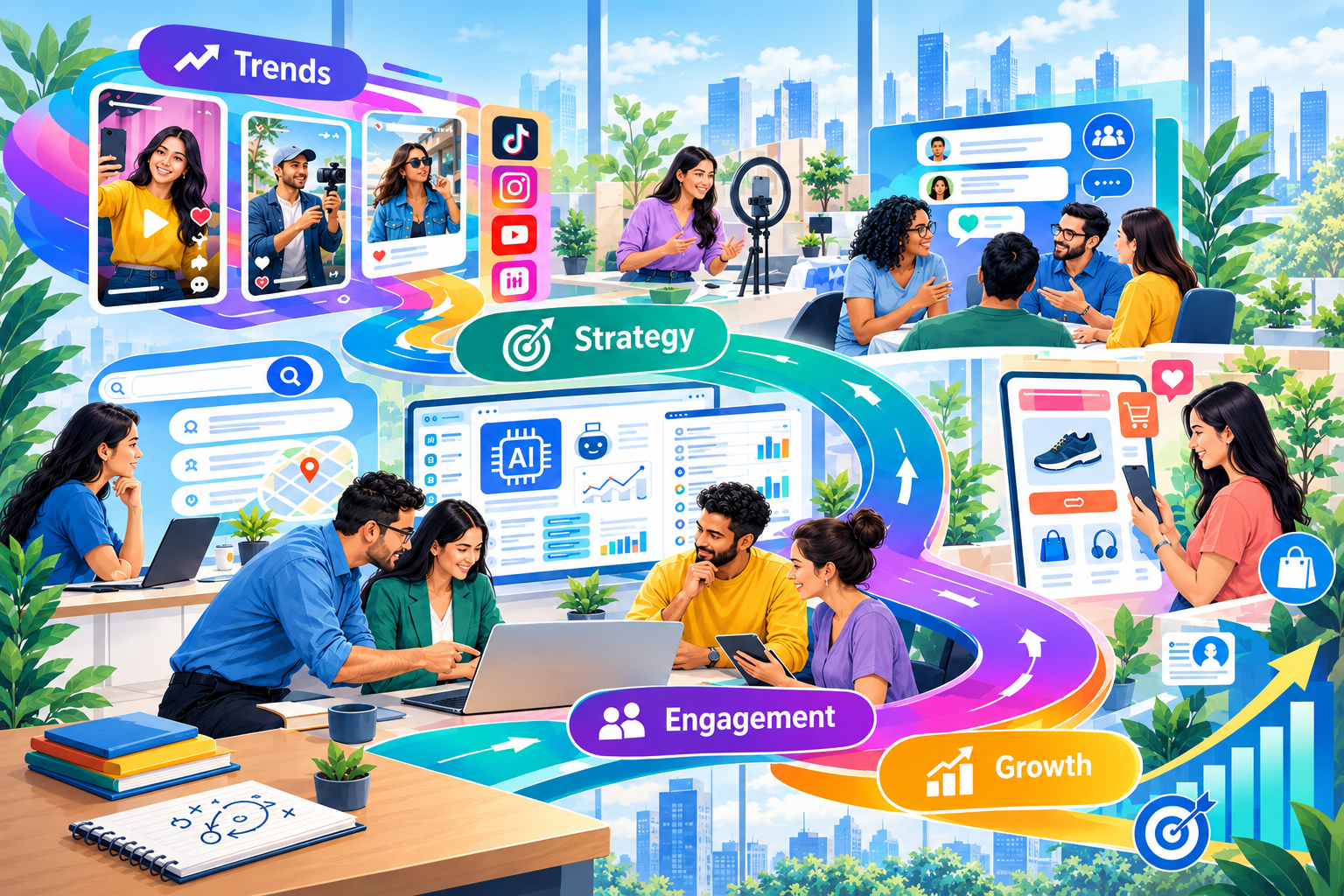
Social media is no longer a place to sell products, share company updates or collect likes. In 2026, it has become a key platform for customers to find a company, evaluate products, engage with brands, and make buying decisions.
It creates both a demand and an opportunity for businesses. Social networks are getting more users and more competition for attention. HubSpot’s 2026 study reports that 73% of marketers feel it’s become harder to stand out, and 67% believe social media will be even more important in the next two years.
Posting every day is no longer enough. Now businesses require a clear social media marketing plan that includes necessary content, human relationships, video, community engagement, and smart use of technology. What will 2026 bring for businesses? Let’s take a look at the major social media marketing trends that can help brands to attract attention, build trust, and generate business.
The Problem:
Social media is more aggressive than it was in its early stages.
Excessive content is the biggest problem that businesses face. Viewers see thousands of posts, videos, ads, and promotional messages every day, so they ignore generic content.
Trying to be active on every platform is another problem. Businesses can open accounts on various social platforms like Instagram, Facebook, LinkedIn, YouTube, TikTok, and X, but very often they struggle to manage them well.
Moreover, a major gap is growing in between what businesses post and what customers actually want.
Audiences want useful information, real-life experiences, quick answers, demos, reviews, and genuine conversations – not endless ads.
More posts are not the solution. The solution is creating better, more relevant content and concentrating on the platforms where your audience spends their time.
1. Short-form video will continue to occupy the throne.
Short-form video in 2026 is the biggest shift in social media marketing.
Businesses can communicate an idea in seconds through Instagram Reels, YouTube Shorts, TikTok videos, and short videos on Facebook. HubSpot’s 2026 study found that short-form video is the format most marketers use and plan to invest in the most.
Businesses can use short-form videos for:
- Product demonstrations
- Tutorials and quick tips
- Questions from customers, behind-the-scenes content
- Fitness & Health
- Foods & recipes
- Fashion & beauty
- Brand Stories
- Feedback from customers
The important thing is that short isn’t shallow. A 30-second video can answer 1 specific customer question and add more value than a long promotional post.
2. Real Content Will Matter More than Perfect Content.
Although businesses have spent years enhancing their social media engagement, audiences are increasingly seeking authentic content and genuine engagement.
As per HubSpot report, most of the social media marketers feel that originality matters more important than production value.
Businesses shouldn’t stop caring about quality. It means quality shouldn’t remove the human element.
A business owner talking directly to the camera about how a product is made, sharing a lesson learned along the way, or introducing the people behind the company can create a stronger connection than a highly designed promotional graphic.
If you were a business in 2026, you’d ask: Is this content written by a human?
If the answer is no, then perhaps it’s time to rethink the approach.
3. AI Will Improve Social Media Marketing, Not Replace Human Creativity
AI is now embedded in everyday marketing processes.
Businesses today use AI tools for content ideas, first drafts, images, video editing, data analysis, and reusing content. According to a recent HubSpot report, 94% of social media marketers use AI in some form in their work.
But don’t publish everything that AI publishes. “AI + human creativity” is the most effective way.
For instance, AI can create ten content ideas in a few minutes. From there, a human marketer can decide which ideas are actually relevant to the audience, add personal experience, fact-check, and give the content a unique voice.
This saves time without sounding robotic to the brand.
4. Social Media Is Turning into a Search Engine.
Gradually, people are turning to social platforms to find out what’s going on.
Nowadays, people may not go straight to a traditional search engine but instead to Instagram to see a local restaurant, TikTok to look at products, YouTube for a tutorial, or LinkedIn for professional advice.
Social search will play an ever-larger role in the discovery journey, particularly for younger consumers, by 2026, HubSpot research finds. In this manner, social media marketing is merging with SEO. Relevant keywords should be included organically in:
- Social media posts
- Text on screen, Video titles
- Profiles & Bios
- Video descriptions, hashtags
This is not keyword spamming. The idea is to make it clear what the content is about so that people and platform search systems can understand it.
5. Focus on Large Community Building
Just having thousands of followers doesn’t mean they have a powerful online community. Businesses need to focus more on conversations, responses and relationships by 2026.
You can build community by engaging with people in real ways—responding to comments, answering questions, starting discussions, creating private groups, using broadcast channels, and encouraging customers to share their experiences.
This is powerful for small businesses, because real conversations build trust without a lot of money spent on advertising.
A question at the end of a post may carry more significant commitment than another promotional message.
6. Broaden the focus on micro-influencers and creators.
Influencer marketing is still a baby. Influencer marketing is still a baby. Now, businesses are starting to work with smaller makers, creators, or inventors—those with a strong connection to a niche audience. Neither are they celebrities nor accounts with millions of followers.
Micro-influencers are useful because their viewers are very concentrated on a particular interest, occupation, location, or lifestyle.
Suppose a local gym can benefit financially by partnering with an established fitness influencer in its city, rather than paying a celebrity with a broad but scattered fan base. But the currency isn’t followers; it’s relevance and credibility.
60% of marketers are looking to invest more in influencer marketing, as reported by HubSpot in 2026.
7. Social commerce will bring discovery and buying closer together.
Now social media is increasingly becoming a centre for content discovery and shopping. It is especially true of businesses that sell tangible products. Shoppable content, product demos, creator collaborations and social advertising can help fulfil the promise of discovery to purchase. This is a trend visible in India.
Meta’s 2026 report shows that Instagram and Facebook are the main platforms for product and brand discovery among Indian customers. Short-form video is an important way for people to discover new products.
Therefore, businesses should think beyond likes and views.
Better question:
Does our social content move someone from awareness to consideration, and finally, conversion?
8. You will fall behind platform-specific content if you publish copy-and-paste content.
You can save time if you share the same content across all the platforms, but it isn’t always the proper approach. Instagram users can reply to Reels and carousel posts.
LinkedIn audiences may want peer insight and practical business lessons. YouTube can host more in-depth educational content, but TikTok often rewards quick, entertaining, native-style videos.
But you don’t need different ideas for every platform. You can adapt one idea.
For example,
- A blog about local SEO might be called
- An Instagram carousel about 3 local SEO mistakes
- A short YouTube video explaining one SEO mistake
- A LinkedIn post on the business impact
- Helpful checklist for Facebook post
This way, you can create several pieces of valuable content from one idea without just copy-and-pasting.
9. Social media customer service will be playing an important role.
Now customers are gradually expecting that businesses will respond on social channels. Their experience can be a comment, direct message or social mention. If you fail to respond to these reactions, it can make your business seem unavailable.
Businesses should not only consider social media a marketing channel.
It can also be used as:
- A channel for user support
- A feedback channel-Reputation management tool
- A source of customer insight
- A platform for relationships
Quick, polite, and useful responses can turn ordinary interactions into opportunities to build trust.
10. Outcomes Will Surpass Vanity Metrics
Likes and follower numbers can look impressive, but they don’t always provide complete insights. A business should link Social Media Marketing to measurable goals.
The useful metrics will depend on the business and can include:
- Traffic to the website
- Rate of engagement
- Watch time (video)
- Profile views
- Click-through rate
- Questions from customers
- Conversion rate
The proper measurements depend on the business goals.
If your goal is to build brand awareness, then reach and visibility might be more important. If the goal is to generate leads, then inquiries and conversions matter more.
The goal is to measure what fuels business growth, not just what looks good on a dashboard.
Benefits of adopting these social media marketing trends
A good strategy for social media can bring you a lot of benefits.
The first is good content that can help you reach out and to attract new customers, even those who don’t know your business.
Second, useful, authentic content builds trust with your customers.
Third, by continuously engaging with your audience, you can build strong customer relationships and foster communities.
Fourth, short-form video and creator content can offer new ways to showcase your products and services.
The bottom line: a comprehensive digital marketing strategy is to bring together social media, SEO, websites, email marketing and paid advertising.
Continual improvement is the secret of success. Don’t try to follow every trend at once. Try the trends that work for your business, your audience and your objectives.
Summary:
Making social media trends a real-life strategy is essential. Social media marketing is shifting quickly in 2026. Short-form video, pure content, AI-powered workflow, social search, influencer marketing, community building, and social commerce are renewing how businesses connect with customers.
But chasing trends for trends’ sake is not a strategy.
A better way is to know your audience, select the right platforms, create helpful content, talk like a human, and measure the results.
Choose one or two areas that align with your business. Keep on improving them. Then move forward after discovering which work will be deemed fit for your viewers.
Professional social media marketing helps you build a clear and sustainable strategy for building a stronger online presence to generate more leads and convert social media activity into measurable business results.
Want to grow your social media followers? Connect with SNPalit Services to discuss your digital marketing goals and create a social media marketing strategy that is customised to meet the needs of your business.